


Blog
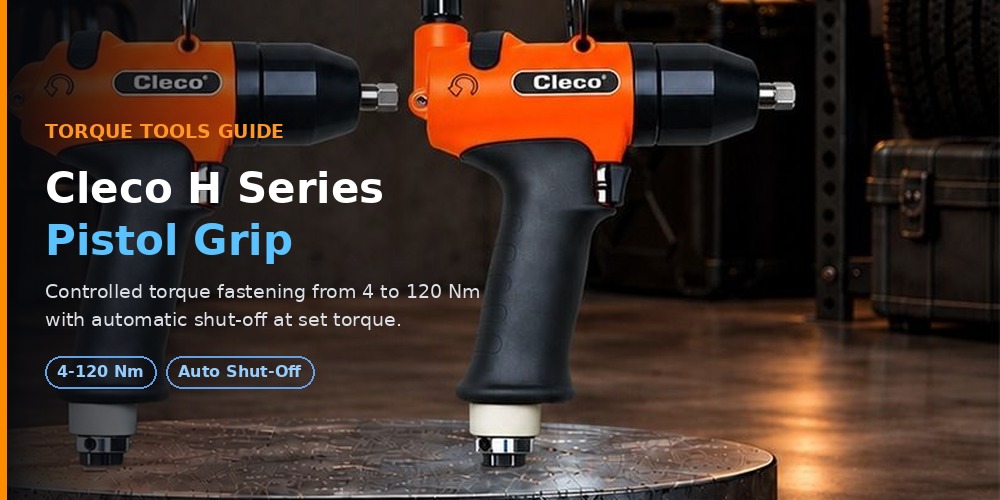
Cleco H Series Pistol Grip: A Practical Guide to Controlled Torque Fastening
Summary:
Getting a fastener to the right torque, every single time, is what separates a reliable assembly line from one that generates rework. The Cleco H Series pistol grip is built around that one job: it delivers controlled torque between 4 and 120 Nm, shuts itself off the moment it hits the set value and does it from a grip shaped for a full shift of use. This guide walks through what the tool actually does, where it fits on an assembly line, how to size it against your fastener and what to check before you order.
Table of Contents
- Why Torque Control Is Not Optional
- What Is the Cleco H Series Pistol Grip?
- Key Features at a Glance
- Where It Earns Its Place on the Line
- Shut-Off vs Non Shut-Off: Which One Do You Need?
- How to Match the Tool to Your Fastening Job
- Getting the Most Out of the Tool
- What Assembly Lines Are Paying Attention To Now
- Where to Buy in India
- Frequently Asked Questions
- Conclusion
1. Why Torque Control Is Not Optional
A fastener that is too loose works itself free under vibration. One that is too tight stretches the bolt, strips the thread or cracks the part it is holding down. Neither failure shows up on the line that day. They show up months later, as a warranty claim, a recall or a machine that fails in the field.
That is why torque control is not a nice-to-have on an assembly line; it is the whole point of the tool. A pistol grip that stops exactly where it should, shift after shift, operator after operator, is what keeps a fastening process out of that failure curve in the first place.
2. What Is the Cleco H Series Pistol Grip?
The H Series pistol grip from Cleco is a pneumatic pulse tool built for controlled industrial fastening.Based on Cleco’s published specifications and our product page, the shut-off version covers a torque range of 2.9 to 88 ft-lb, or 4 to 120 Nm, which puts it squarely in the range most general assembly, automotive component, and appliance fastening work calls for.
It runs on a 3-chamber air motor with an inertia shut-off mechanism, meaning the tool senses when it has reached the set torque and cuts air supply right there, rather than relying on the operator’s feel or a timer. That is the difference between a tool that assists an operator and a tool that actually controls the outcome.
3. Key Features at a Glance
- 4 to 120 Nm torque range on the shut-off H Series model, enough for small fasteners through to moderately sized structural bolts
- Automatic shut-off at set torque, cutting air the instant the fastener reaches target, which protects against both under- and over-tightening
- Inertia shut-off design, Cleco’s standard mechanism for repeatable, low-scatter torque results
- 3-chamber air motor for efficient, consistent power delivery
- Ergonomic pistol grip, shaped to reduce operator fatigue over long shifts
- External speed control to fine-tune run-down speed for the application
- Oil-less blades with a reversible torque signal port, which keeps maintenance simple and supports both forward and reverse fastening setups
- Low noise operation, a genuine consideration on crowded assembly floors
- Quick change adaptor available (935472, 3/8″ square to 7/16″ quick change), useful if your bit inventory is built around quick-change sockets
4. Where It Earns Its Place on the Line
| Application | Why the H Series Fits |
| Automotive component assembly | Controlled torque on brackets, panels and sub-assemblies where consistency matters across thousands of units |
| Appliance manufacturing | Mid-range torque suits chassis and housing fasteners without risking plastic or thin-gauge metal damage |
| General industrial assembly | A dependable, shift-long tool for production lines running repetitive fastening cycles |
| Machine and equipment building | Structural and bracket fasteners that fall in the 4-120 Nm band |
| Maintenance and rework stations | A single tool that covers a wide torque band, reducing how many tools a technician needs on hand |
5. Shut-Off vs Non Shut-Off: Which One Do You Need?
Cleco builds the H Series in both shut-off and non shut-off versions and the difference matters more than it might look on paper.
| Factor | Shut-Off Model | Non Shut-Off Model |
| How it stops | Cuts air automatically at set torque | Keeps running; operator judges completion by feel or pulse count |
| Repeatability | High, tool-controlled | Depends on operator skill and consistency |
| Best for | Safety-critical or quality-controlled fastening | Lower-stakes fastening where some torque variation is acceptable |
| Operator training | Less critical, since the tool enforces the cutoff | More important, since judgment plays a bigger role |
| Typical use | Automotive, appliance, regulated assembly | General workshop or lower-tolerance tasks |
If your process has any quality sign-off, warranty exposure or safety implication, the shut-off version is the one to specify. It is also the version we carry as the primary H Series pistol grip on our product page.
6. How to Match the Tool to Your Fastening Job
Picking the right torque tool is less about the biggest number on the spec sheet and more about matching the tool to the fastener.
- Find your target torque first. Check the fastener manufacturer’s or OEM’s torque specification before anything else.
- Stay inside the tool’s working band, not at its edges. A tool running near the very top or bottom of its rated range tends to lose repeatability. If your target torque sits right at 120 Nm, look at Cleco’s C Series, which covers 100-400 Nm, instead of pushing the H Series to its limit.
- Decide on drive type. Square drive suits standard sockets; quick change suits faster bit-swapping on mixed-fastener lines.
- Check your air supply. Pulse tools need a steady, adequately sized air line. Confirm your plant’s air pressure and flow against the tool’s requirement before committing.
- Think about audit and traceability needs. If your process needs recorded torque values rather than just a shut-off action, an electronic option such as Cleco’s ETWA Advanced Electronic Torque Wrenches may be a better fit than a pneumatic pulse tool.
7. Getting the Most Out of the Tool
A good tool still needs a few basics to keep performing at its rated accuracy:
- Run it on clean, properly regulated air: Pressure that drifts changes torque output, even on a shut-off tool.
- Check calibration periodically: especially in any quality-controlled process. A shut-off mechanism does not mean “set and forget” forever.
- Match the socket or bit to the fastener exactly: A loose-fitting socket adds scatter to torque results no matter how good the tool is.
- Keep the air line properly sized: since an undersized hose starves the tool of the flow it needs at peak demand.
- Service the air motor on schedule: The oil-less blade design keeps day-to-day maintenance light, but it is not maintenance-free forever.
8. What Assembly Lines Are Paying Attention To Now
- Traceable torque data is becoming standard even outside regulated industries, pushing more lines toward electronic or hybrid controllers rather than purely mechanical shut-off tools for critical joints.
- Ergonomics as a retention issue, not just a comfort one. Lighter, better-balanced pistol grip tools reduce repetitive strain claims and operator turnover on high-cycle stations.
- Mixed fleets, where pneumatic pulse tools like the H Series handle high-volume, lower-criticality joints, while electronic torque wrenches cover the safety-critical fasteners that need a logged value.
- Preventive air system maintenance is important, since inconsistent line pressure is one of the most common and most overlooked causes of torque drift on pneumatic tools.
9. Where to Buy in India
Sanjay Tools & Accessories is an authorised distributor for Cleco torque tools in India. You can go directly to the H Series 2.9-88 ft-lb / 4-120 Nm Pistol Grip Shut-Off page, or look at the higher-torque C Series Pistol Grip if your fasteners run past 120 Nm.
For assembly lines that also need electronic torque control and data logging, see the Cleco ETWA Advanced Electronic Torque Wrenches.
Call: 020-46925638 / +91-9607983486
10. Frequently Asked Questions
- What torque range does the Cleco H Series pistol grip cover?
- The shut-off model covers 2.9 to 88 ft-lb, or 4 to 120 Nm, which suits most general industrial, automotive component and appliance assembly fastening work.
- How does the automatic shut-off actually work?
- The tool uses an inertia shut-off mechanism. As the fastener approaches target torque, the motor’s deceleration triggers the shut-off, cutting the air supply at that point rather than relying on a timer or operator judgment.
- Is the H Series suitable for safety-critical fastening?
- It is well suited to controlled, repeatable fastening in that torque band, but if your process requires a recorded, traceable torque value for every fastener, an electronic torque wrench such as Cleco’s ETWA range is the better choice.
- What drive options are available on the H Series?
- It is available with square drive as standard, with a 3/8″ square to 7/16″ quick change adaptor (part 935472) available separately for shops that prefer quick-change bit systems.
- How often should a pneumatic torque tool like this be checked for accuracy?
- There is no single interval that fits every plant, but any process with a quality or safety requirement should calibrate and verify the tool on a defined schedule, not just when something seems off. Air pressure stability also matters as much as the tool itself.
11. Conclusion
The Cleco H Series pistol grip earns its place on an assembly line by doing one job well: stopping at the right torque, every time, without asking the operator to guess. For fastening work in the 4 to 120 Nm range, it combines that repeatability with a grip built for a full shift of use, which is exactly what keeps rework and warranty claims off the table later.
Need help specifying the right torque tool for your line? Call 020-46925638 or request a quote for the Cleco H Series pistol grip and our team will help you match it to your fastener and process.


