


Blog
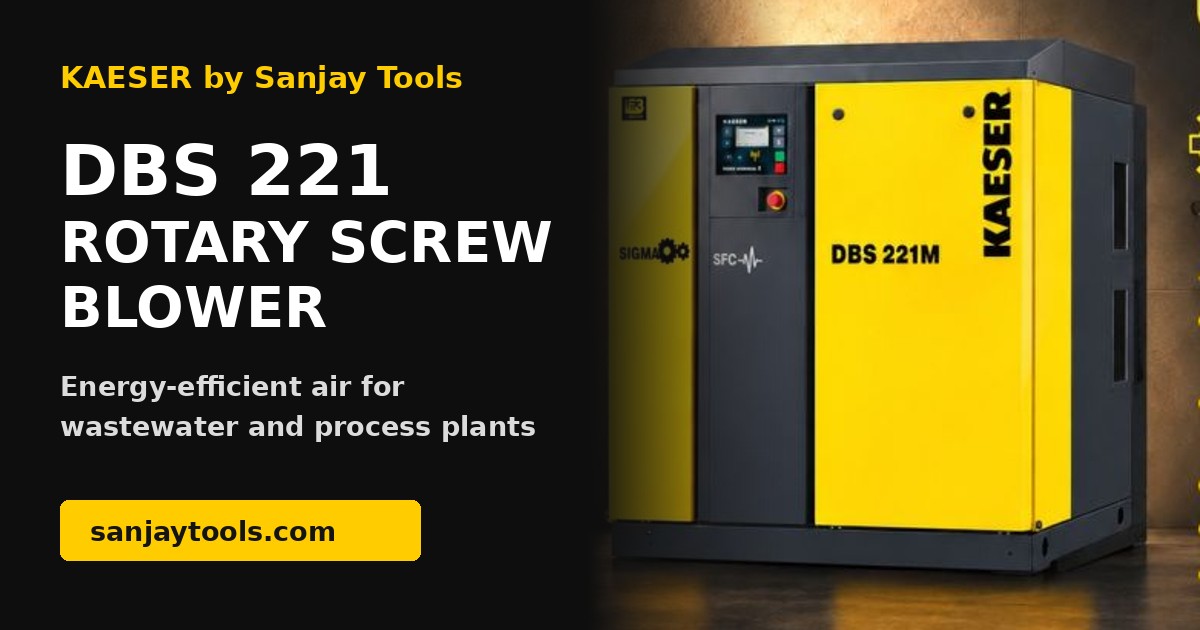
Kaeser DBS 221 Rotary Screw Blower: Energy-Efficient Air for Wastewater, Conveying and Process Plants
Summary
The Kaeser DBS 221 rotary screw blower is a compact, connection-ready unit rated up to 37 kW, built for plants that need steady low-pressure air all day, every day. It suits wastewater aeration, pneumatic conveying, food and beverage processing, textile units and water treatment. This guide explains what the DBS 221 actually delivers, how it differs from a compressor and from a lobe blower, how to size it and what to check before you order.
Table of Contents
- Blower or Compressor? Get This Right First
- What Is the Kaeser DBS 221 Rotary Screw Blower?
- Technical Data by Model
- Where the DBS 221 Fits Best
- Rotary Screw Blower vs Lobe Blower
- How to Size a Blower for Your Plant
- Low Maintenance in Real Terms
- What Plants Are Paying Attention To Now
- Where to Buy in India
- Frequently Asked Questions
- Conclusion
1. Blower or Compressor? Get This Right First
I have seen more than one plant order a compressor when the job needed a blower, and the other way round. The difference comes down to pressure and volume.
A compressor works at high pressure, typically 7 to 13 bar, and suits tools, cylinders and automation. A blower moves a large volume of air at low pressure, usually below about 1.1 bar (1,100 mbar). If your process is aeration, fluidising, conveying light material or creating a vacuum, you want a blower. Using a compressor there wastes a lot of energy.
The Kaeser DBS 221 belongs in the blower category.
2. What Is the Kaeser DBS 221 Rotary Screw Blower?
The DBS 221 sits in the middle of Kaeser’s blower range. It is a complete package: the airend, motor, sound-insulating enclosure, control cabinet and sensors come together as one unit, ready to connect.
Based on Kaeser’s published data and our product page, the main points are:
- Up to 37 kW motor power, with flow rates up to 23 m³/min
- Pressure differentials up to 1,100 mbar and vacuum up to -550 mbar
- Kaeser’s SIGMA PROFILE rotors, which Kaeser states can save up to 35 percent energy compared with conventional blower systems
- Fixed speed (STC) and variable speed (SFC) versions
- SIGMA CONTROL 2 controller for real-time monitoring, and Industrie 4.0 compatibility
- Delivered ready to install, with sensors an emergency stop and oil fill already done
- Performance guaranteed per ISO 1217
3. Technical Data by Model
| Model | Max. Pressure Differential | Max. Flow Rate | Max. Motor Power | Pipe Connection |
| DBS 221 L SFC | 700 mbar | 23 m³/min | 30 kW | DN 100 |
| DBS 221 L STC | 700 mbar | 19 m³/min | 22 kW | DN 100 |
| DBS 221 M SFC | 1,100 mbar | 22 m³/min | 37 kW | DN 100 |
| DBS 221 M STC | 1,100 mbar | 18 m³/min | 37 kW | DN 100 |
Dimensions with control cabinet are 1,110 x 1,480 x 1,670 mm (W x D x H) and the maximum weight is about 850 kg. Data as published by Kaeser; always confirm the exact figures on the current datasheet for your order.
The “L” versions suit lower pressure and slightly higher flow. The “M” versions go to the full 1,100 mbar for deeper tanks or longer conveying lines. SFC means variable speed, STC means fixed speed.
4. Where the DBS 221 Fits Best
| Application | Why It Works |
| Wastewater treatment (small to medium plants) | Steady, oil-free aeration air for biological treatment, and the unit can run at 100 percent duty |
| Pneumatic conveying of light bulk materials | Enough volume and pressure for powders and granules over moderate distances |
| Food and beverage processing | Clean, oil-free air for process use where contamination is a concern |
| Textile industry | Reliable air for process and conveying needs on continuous shifts |
| Water treatment plants | Air for flotation, fluidisation and filter backwash |
5. Rotary Screw Blower vs Lobe Blower
| Factor | Kaeser Rotary Screw Blower | Conventional Lobe Blower |
| Energy use | Lower, especially with variable speed | Generally higher |
| Flow control | Wide range with SFC models | Limited without extra equipment |
| Purchase cost | Higher upfront | Lower upfront |
| Maintenance | Low, sealed and gear-driven design | More routine attention |
| Best for | Long running hours, varying air demand | Short duty, tight budgets |
A lobe blower can look cheaper on the quotation. But if the machine runs 6,000 to 8,000 hours a year, the power bill matters far more than the purchase price. That is where a screw blower usually pays back.
6. How to Size a Blower for Your Plant
Rules of thumb only go so far, but this is the approach we use with customers:
- Work out the pressure first. For aeration, every metre of water depth needs roughly 100 mbar. Add losses from pipework, valves, filters and diffusers, usually another 100 to 200 mbar. That decides between the L and M versions.
- Then the flow. Calculate total air demand from your process load, then add a sensible margin. Do not oversize by a huge amount, because a blower running far below its ideal range wastes energy.
- Decide fixed or variable speed. If demand is steady, STC works. If demand swings through the day, SFC saves real money.
- Check the site. Ambient temperature, altitude, dust and available floor space all affect performance and enclosure choice.
- Plan the piping. A DN 100 outlet means your air line must be sized to match, or you lose the efficiency you paid for.
If you are unsure, send us your process details and we will help you choose between the DBS 221 and the neighbouring CBS 121 or larger Kaeser blowers.
7. Low Maintenance in Real Terms
“Low maintenance” gets said about every machine. With the DBS 221, it comes down to a few design choices:
- Power is transmitted through maintenance-free gearing
- Cylindrical roller bearings are built for a long service life
- The rotor housing seal is maintenance-free
- Standard service work is limited to oil, filters and routine inspection
Even so, a blower is only as reliable as its intake air. Keep the intake filter clean, keep the enclosure vents clear and log operating hours so servicing happens on time.
8. What Plants Are Paying Attention To Now
- Energy audits: with power costs rising, more plants are checking blower efficiency, and Kaeser’s controller supports audits in line with ISO 50001.
- Variable speed as the default: wastewater load changes through the day and SFC models follow it.
- Remote monitoring: Industrie 4.0 connectivity lets maintenance teams see running data without walking to the machine.
- Ready-to-run packages: less site fabrication means shorter installation and commissioning time.
9. Where to Buy in India
Sanjay Tools & Accessories supplies the full Kaeser blower range across India. You can go directly to the Kaeser DBS 221 Rotary Screw Blower 37 kW page, or look at larger models such as the Kaeser GBS 1050.
If your plant also runs compressed air, we can supply AIRpipe aluminium piping for distribution and SUTO flow and dew point meters to track consumption.
Call: 020-46925638 / +91-96079 83486
10. Frequently Asked Questions
- What is the Kaeser DBS 221 rotary screw blower used for?
A. It supplies steady, low-pressure air for wastewater aeration, pneumatic conveying of light bulk materials, food and beverage processing, textile plants and water treatment. - What is the difference between a blower and a compressor?
A. A blower delivers a large volume of air at low pressure, up to about 1,100 mbar for the DBS 221. A compressor delivers smaller volumes at much higher pressure, typically 7 bar and above. - What power and flow does the DBS 221 offer?
A. Depending on the model, it goes up to 37 kW with flow rates up to 23 m³/min and pressure differentials up to 1,100 mbar. - Should I choose a fixed speed (STC) or variable speed (SFC) model?
A. Choose STC for steady, predictable demand. Choose SFC if your air demand changes through the day, since the blower adjusts its output and saves energy. - Does the DBS 221 need a lot of maintenance?
A. No. It uses maintenance-free gearing and a maintenance-free rotor housing seal. Routine work is mainly oil, filters and inspection, done to the schedule in the Kaeser manual.
11. Conclusion
The Kaeser DBS 221 rotary screw blower suits plants that need dependable mid-range air at low pressure, without a heavy power bill or constant servicing. Pick the model by pressure and flow, choose variable speed if your demand moves, and keep the intake clean. Get those three things right and the unit will run for years with very little fuss.
Planning a new aeration system or replacing an old blower? Call 020-46925638 or request a quote for the Kaeser DBS 221 and our team will help you size it correctly.


