

Blog
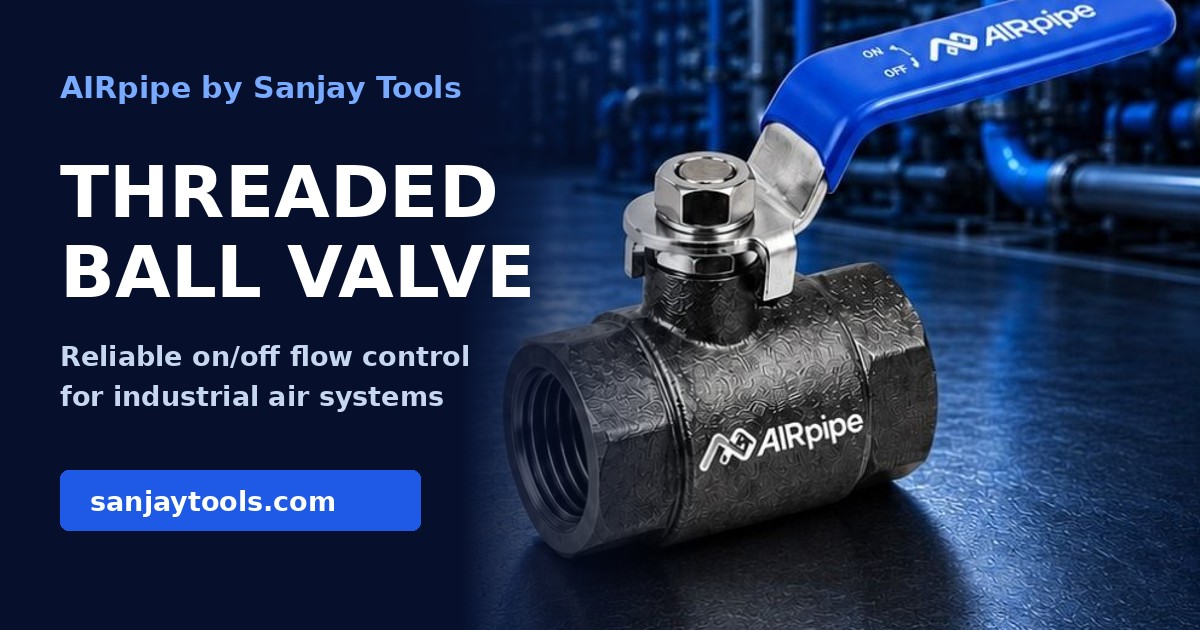
AIRpipe Threaded Ball Valve: Reliable On/Off Control for Industrial Compressed Air Systems
Summary
Every compressed air line needs points where you can shut the air off cleanly, whether for maintenance, a machine changeover or a leak repair. The AIRpipe threaded ball valve does that job with a quarter-turn lever, a threaded body that screws straight onto your fittings, and a design made for AIRpipe’s aluminium piping. This guide covers where to fit it, how to choose the right size and thread, how it compares to other valve types, and the installation mistakes I have seen cause the most trouble on plant floors.
Table of Contents
- Why the Isolation Valve Matters More Than People Think
- What Is an AIRpipe Threaded Ball Valve?
- Key Features at a Glance
- Where to Fit It in Your Compressed Air Line
- Ball Valve vs Gate Valve vs Butterfly Valve
- How to Choose the Right Size and Thread
- Installation Tips From the Shop Floor
- What Plants Are Paying Attention To Now
- Where to Buy in India
- Frequently Asked Questions
- Conclusion
1. Why the Isolation Valve Matters More Than People Think
Ask a maintenance engineer what slows down a repair on a compressed air line and the answer is usually the same: nobody can isolate the section quickly. Either there is no valve where it is needed or the old one is stuck, weeping or half-seized. So the whole line gets shut down to fix one drop leg.
That is a lot of lost production for a fitting that costs a fraction of one hour of downtime. It is also why I always tell plant managers to plan valve positions at the design stage, not after the first breakdown.
2. What Is an AIRpipe Threaded Ball Valve?
A ball valve controls flow with a ball that has a hole through the middle. Turn the lever a quarter turn and the hole either lines up with the pipe (open) or turns sideways to block it (closed). No multiple turns, no guessing. You can see the state of the valve at a glance from the handle position.
The AIRpipe threaded ball valve is a shut-off valve made for AIRpipe’s compressed air piping systems. As per ourproduct page, it is typically built from brass or nickel-plated brass, comes with threaded connections (female NPT or male threads) and often includes a locking handle. It works for compressed air, vacuum and inert gas lines, and is rated for temperatures from -4°F to 176°F (roughly -20°C to 80°C).
It is available in 1/2 inch, 3/4 inch, 1 inch and 2 inch sizes.
3. Key Features at a Glance
- Reliable on/off flow control: the quarter-turn lever gives a clear open or closed position, marked ON and OFF on the handle
- Durable threaded construction: a solid threaded body that holds up to daily plant use and can be removed and refitted when the layout changes
- Easy integration into air systems: threads straight into AIRpipe adapters and fittings without special tools or welding
- Locking handle option: helps prevent accidental or unauthorised operation during maintenance
- Leak-focused design: built to shut off cleanly and keep compressed air where it belongs
4. Where to Fit It in Your Compressed Air Line
From years of looking at plant layouts, these are the positions where a threaded ball valve earns its place:
- At the start of every drop leg, so one workstation can be isolated without touching the main ring
- Before and after filters, regulators and lubricators, so the unit can be serviced with the line still running
- At the compressor room outlet, between the compressor, dryer and main distribution line
- On branch lines feeding separate departments, useful during shift-wise or section-wise shutdowns
- Ahead of hose reels and point-of-use tools, where a quick shut-off saves air every time a tool is removed
If you are building or extending a line, pair the valve with AIRpipe’sFemale Threaded Straight Quick Drop,Airpipe Male Threaded Adapter orAluminium 90 Degree Elbow Female Thread so the whole run stays on one system.
5. Ball Valve vs Gate Valve vs Butterfly Valve
| Factor | Threaded Ball Valve | Gate Valve | Butterfly Valve |
| Operation | Quarter turn | Multiple turns of a wheel | Quarter turn or handwheel |
| Speed of shut-off | Very fast | Slow | Fast |
| Open/closed indication | Visible from handle position | Harder to judge | Visible on lever types |
| Best size range in compressed air | Small and medium branch lines (1/2″ to 2″) | Older systems, less common now | Large main lines (AIRpipe offers 100mm and above) |
| Sealing when closed | Tight shut-off | Can weep with wear | Depends on seat condition |
| Best use | Isolation on drops and branches | Rarely specified in new work | Main line isolation |
For larger main lines, take a look at our guide to theAirPipe butterfly valve with wheel handle. For branches and drop legs, the threaded ball valve is usually the more practical choice.
6. How to Choose the Right Size and Thread
Match the valve to the line, not to the tool. A 1/2 inch valve on a 1 inch branch will choke the flow and waste energy. Choose a valve close to the bore of the line it sits on.
A rough guide, based on typical plant use (always confirm against your actual air demand):
| Valve Size | Typical Position |
| 1/2 inch | Single-tool drops, small workstations |
| 3/4 inch | Workstation branches, FRL units |
| 1 inch | Department branch lines |
| 2 inch | Larger branches, compressor room outlets |
Check the thread standard before you order. The product page lists NPT threads, while many older Indian plants run BSP on their equipment. Tapered and parallel threads do not seal properly against each other, and mixing them is a very common cause of slow leaks. Tell us your thread type when you enquire and we will confirm compatibility.
Confirm the pressure rating for your system. Most plant networks run in the 7 to 10 bar range, but always check the working pressure against the datasheet, and ask us if you run higher.
7. Installation Tips From the Shop Floor
- Depressurise and isolate the line before you touch anything. Sounds obvious, gets skipped more often than it should.
- Clean the threads. Metal shavings or old sealant left in the thread will end up inside the valve.
- Use the right sealant, and use it sparingly. Too much PTFE tape ends up as debris in your tools downstream.
- Tighten with a spanner on the valve body, not the handle. Levering on the handle can damage the stem.
- Leave room for the handle to swing a full quarter turn. A valve you cannot fully operate is a valve nobody will use.
- Test with soapy water or an ultrasonic leak detector after bringing the line back up to pressure.
- Label and log it. A simple tag showing which section the valve isolates saves a lot of confusion during an emergency shutdown.
8. What Plants Are Paying Attention To Now
- Leak audits: a commonly quoted industry figure is that 20 to 30 percent of compressor output can be lost to leaks in poorly maintained systems. Isolation valves make it possible to test and repair one section at a time.
- Safer maintenance practice: more plants are adding lockable isolation points to support lockout and tagout procedures.
- Moving away from old galvanised pipe: corrosion-free aluminium systems keep rust out of the air, which also supports compliance withISO 8573-1 air quality targets.
- Modular layouts: production lines change often, and threaded, reusable valves make it easy to reconfigure without cutting or welding.
9. Where to Buy in India
Sanjay Tools & Accessories is the authorised channel partner forAIRpipe in India.You can see the full range in ourAIRpipe product category or go straight to theAIRpipe Threaded Ball Valve page for sizes and details.
Setting up a complete compressed air system? We also supplyKaeser compressors and blowers andSUTO flow and dew point instruments to go with it.
Call: 020-46925638 / +91-96079 83486
10. Frequently Asked Questions
- What is an AIRpipe threaded ball valve used for?
A. It is used to switch compressed air, vacuum or inert gas flow on and off in AIRpipe piping systems. Typical spots are drop legs, branch lines, filter and regulator units and compressor room outlets. - What sizes does the AIRpipe threaded ball valve come in?
A. According to our product page, it is available in 1/2 inch, 3/4 inch, 1 inch and 2 inch sizes. Contact our team if you are unsure which one suits your line. - Can I use a ball valve to control or throttle airflow?
A. A ball valve is designed for on/off duty. Leaving it partly open for long periods can wear the seat. If you need to adjust flow or pressure, fit a regulator or flow control valve alongside it. - Are threaded ball valves suitable for vacuum and inert gas lines?
A. Yes. Along with compressed air, the AIRpipe threaded ball valve is designed for vacuum and inert gas applications, within its rated temperature and pressure limits. - How do I stop a threaded ball valve from leaking at the joint?
A. Most joint leaks come from dirty threads, too much or too little sealant or a mismatch between NPT and BSP threads. Clean the threads, use the right sealant, match the thread type and pressure-test after installation.
11. Conclusion
A valve you can trust is one of the cheapest ways to keep a compressed air system easy to maintain. The AIRpipe threaded ball valve gives you a clear on/off position, a solid threaded body and simple integration with AIRpipe fittings, all of which cut down repair time and wasted air. Plan your isolation points early, match the size and thread to your line, and test every joint after fitting.
Planning a new line or upgrading your existing air network? Call 020-46925638 orrequest a quote for AIRpipe threaded ball valves and our team will help you choose the right size and thread.