

Blog
Kaeser Rotary Screw Compressors: Reliable Compressed Air for Industrial Applications
Summary
Compressed air is an essential utility in many manufacturing plants. It powers pneumatic tools, supports automated production lines, operates control systems and assists with a wide range of industrial processes. When the compressor cannot meet the plant’s air demand or maintain the required pressure, production efficiency and equipment performance can be affected.
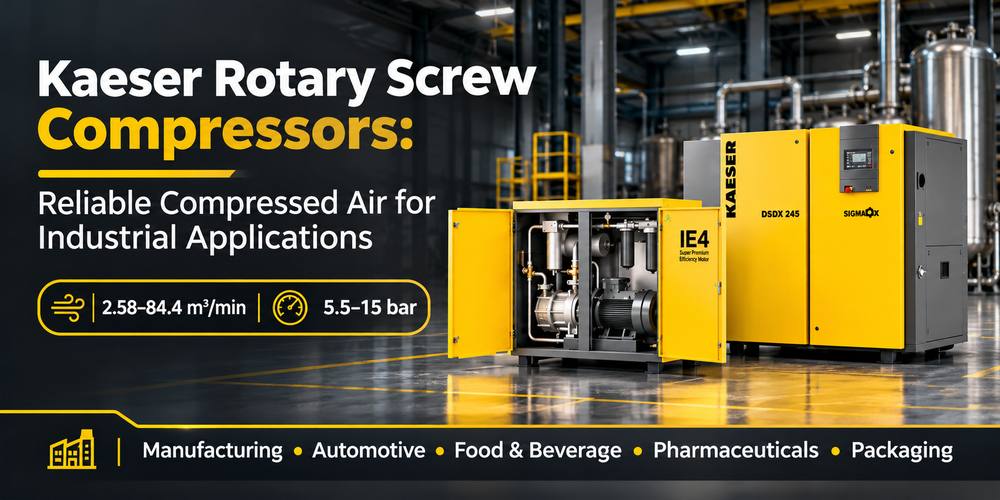
Kaeser rotary screw compressors are designed for industrial compressed air requirements across different operating conditions. The ASD to HSD 1:1 drive series featured in this range offers flow rates from 2.58 to 84.4 m³/min and pressure options from 5.5 to 15 bar. Different versions, including Standard, T, SFC and T SFC, provide options for varying installation and operating requirements.
This guide explains how rotary screw compressors work, where they are used, what to consider before selecting one and how Sanjay Tools & Accessories Pvt. Ltd. can help manufacturers explore suitable Kaeser compressed air solutions.
Table of Contents
- What Is a Rotary Screw Compressor?
- How Does a Rotary Screw Compressor Work?
- Understanding the Kaeser Rotary Screw Compressor Range
- Important Features of Kaeser Compressors
- Industrial Applications of Rotary Screw Compressors
- How to Select the Right Industrial Air Compressor
- Why Compressed Air System Design Matters
- Kaeser Compressors from Sanjay Tools & Accessories
- Frequently Asked Questions
- Conclusion
1. What Is a Rotary Screw Compressor?
A rotary screw compressor is an industrial machine that produces compressed air using two intermeshing screw rotors. As the rotors turn, air enters the compression chamber, becomes trapped between the rotor profiles and the housing, and is compressed as it moves towards the discharge side.
Unlike compressors that deliver air in separate compression strokes, rotary screw compressors are commonly used where a steady supply of compressed air is required over extended operating periods.
Manufacturing plants use compressed air for several purposes, including:
- Operating pneumatic tools and machinery.
- Supporting automated assembly lines.
- Running pneumatic cylinders and actuators.
- Operating material-handling equipment.
- Supporting packaging and production processes.
- Supplying air to selected cleaning and process applications.
The compressor must be selected according to the actual air demand, pressure requirement, operating hours and quality of air needed by the application.
2. How Does a Rotary Screw Compressor Work?
The compression process begins when ambient air enters the compressor through an intake system. The air then moves into the compression element, where two rotating screw profiles reduce the available volume and increase air pressure.
The compressed air passes through the discharge system and, depending on the compressor configuration, may then move through an aftercooler, dryer, filters and the plant’s distribution network.
A typical compressed air installation includes:
- Air intake: Ambient air enters the compressor through the intake arrangement.
- Compression element: The screw rotors compress the incoming air.
- Cooling and separation: The compressed air is cooled and treated according to the compressor design.
- Air treatment: Dryers and filters help achieve the required air quality.
- Distribution: Treated compressed air travels through the piping network to points of use.
The compressor is only one part of the complete system. Air treatment, storage, piping, pressure losses and demand patterns also influence how effectively compressed air reaches production equipment.
3. Understanding the Kaeser Rotary Screw Compressor Range
Kaeser offers rotary screw compressor models for different industrial air requirements. The ASD to HSD series with 1:1 drive, listed by Sanjay Tools, covers a flow range of 2.58 to 84.4 m³/min and pressure options from 5.5 to 15 bar.
These specifications provide a broad selection for plants with different compressed air demands. The required model should be selected after evaluating the plant’s actual air consumption and operating pressure.
Key specifications
| Parameter | Listed range |
| Compressor series | ASD to HSD |
| Drive configuration | 1:1 drive |
| Flow rate | 2.58 to 84.4 m³/min |
| Pressure | 5.5 to 15 bar |
| Available versions | Standard, T, SFC, T SFC |
| Rotor profile | SIGMA PROFILE |
The flow and pressure figures refer to the ASD to HSD 1:1 drive range listed on the Sanjay Tools website. They should not be interpreted as the specification of every Kaeser compressor model.
Available versions
The listed range includes different versions to suit varying system configurations:
- Standard: The standard compressor configuration.
- T: A version designation available within the listed range. Confirm the exact configuration and included equipment for the selected model.
- SFC: A variable-speed version designation.
- T SFC: A combination of the T and SFC designations.
The final selection should be based on the specific model datasheet, installation requirements and operating conditions.
4. Important Features of Kaeser Compressors
SIGMA PROFILE airend
The Kaeser range highlighted by Sanjay Tools features the SIGMA PROFILE. The compressor’s airend is central to the compression process, and its design is an important consideration when evaluating an industrial compressor.
Broad flow and pressure options
The ASD to HSD 1:1 drive range covers 2.58–84.4 m³/min and 5.5–15 bar. This range allows plant teams to assess different compressor sizes against their required air delivery and pressure.
Multiple configuration options
Standard, T, SFC and T SFC versions are listed for the range. These options make it important to compare the exact configuration rather than selecting a compressor based only on its series name.
Suitability for industrial operations
Rotary screw compressors are commonly considered for manufacturing environments that need a continuous and dependable compressed air supply. The appropriate model depends on the plant’s load profile, operating hours and air demand.
5. Industrial Applications of Rotary Screw Compressors
Compressed air is used across industries, but each application has different pressure, flow and air-quality requirements. The compressor and supporting equipment should be selected accordingly.
General manufacturing and assembly lines
Pneumatic tools, actuators, fixtures and automated equipment rely on compressed air for routine operations. A correctly sized compressor helps meet the combined air demand of the production area.
Automotive production
Automotive manufacturing uses compressed air across assembly operations, pneumatic equipment and selected production processes. Air demand can vary between production areas, so system sizing should account for simultaneous equipment use.
Food and beverage processing
Compressed air may be used for packaging, conveying, automation and other production activities. Where air can contact products or product-contact surfaces, the required air quality must be established separately. Appropriate dryers, filters and monitoring may be necessary.
Pharmaceutical manufacturing
Pharmaceutical facilities have process-specific requirements for compressed air quality and system control. Compressor selection must be considered alongside filtration, drying, monitoring and applicable quality procedures.
Packaging operations
Packaging lines use compressed air for actuators, pneumatic controls, product handling and machine movements. Stable pressure and adequate flow are important when several machines operate together.
The applications above are examples of where industrial compressed air is used. The required compressor capacity, pressure and treatment configuration will differ from plant to plant.
6. How to Select the Right Industrial Air Compressor
Selecting a compressor based only on motor power or the highest available flow rate can result in an unsuitable installation. A proper assessment should begin with the production process.
6. 1. Calculate actual air demand
List the equipment that uses compressed air and determine its consumption. Consider which machines operate simultaneously and whether demand changes during different shifts.
6. 2. Confirm the operating pressure
Identify the pressure required at the point of use. Also account for pressure losses through dryers, filters, valves, regulators and distribution piping.
6. 3. Review operating hours
A plant running multiple shifts has different operating requirements from a facility using compressed air for a few hours each day. The operating schedule helps determine the appropriate compressor arrangement.
6. 4. Consider variable air demand
If compressed air consumption changes considerably throughout the day, discuss whether a variable-speed configuration is suitable. The SFC version listed in the Kaeser range may be relevant for applications where demand variation needs to be assessed.
6. 5. Identify air-quality requirements
The compressor alone does not determine the final compressed air quality. Depending on the application, the system may require refrigerated or desiccant dryers, filters, condensate management and monitoring equipment.
6. 6. Plan the complete installation
Consider the compressor room, ventilation, electrical supply, maintenance access, air receiver, piping layout and future capacity requirements before finalising the equipment.
A technical review of these points helps avoid choosing a compressor that is either undersized for production or larger than the actual requirement.
7. Why Compressed Air System Design Matters
Even a correctly selected compressor can deliver poor results if the supporting system is not designed properly.
For example, an undersized distribution line can cause pressure drops when multiple machines operate at the same time. Poor condensate management can allow moisture to enter downstream equipment. Inadequate filtration may also affect applications that require cleaner compressed air.
A complete system assessment should therefore include:
- Compressor capacity and operating pressure.
- Air receiver sizing.
- Dryer selection.
- Filtration requirements.
- Condensate drainage and management.
- Distribution piping size and layout.
- Leakage inspection.
- Compressed air monitoring where required.
For plants with specific compressed air purity requirements, air quality should be verified using suitable measurement methods. Compressor selection by itself does not establish compliance with a particular air-quality class.
8. Kaeser Compressors from Sanjay Tools & Accessories
Sanjay Tools & Accessories Pvt. Ltd. is an authorised industrial products channel partner serving customers across India and the Gulf region. Its product portfolio includes Kaeser compressed air equipment and related industrial solutions.
The Kaeser range available through Sanjay Tools includes rotary screw compressors, blowers and other compressed air products. The company also provides maintenance services for its Kaeser compressor division.
For manufacturers evaluating a rotary screw compressor, the selection process should consider the required flow rate, pressure, operating schedule, installation conditions and air-treatment requirements.
Explore the availableKaeser rotary screw compressors with 1:1 drive andKaeser rotary screw compressors with V-belt drive.
You can also browse the completeKaeser product range available from Sanjay Tools.
9. Frequently Asked Questions
- What is a rotary screw compressor used for?
A. A rotary screw compressor supplies compressed air for industrial applications such as pneumatic tools, assembly lines, automated machinery, packaging equipment and selected manufacturing processes.
- What is the flow rate of the Kaeser ASD to HSD 1:1 drive range?
A. The listed Kaeser ASD to HSD 1:1 drive range has flow rates from 2.58 to 84.4 m³/min. The actual flow rate depends on the selected model and its operating conditions.
- What pressure range is available in this Kaeser compressor range?
A. The listed pressure range is 5.5 to 15 bar. The required operating pressure should be established according to the equipment and production process.
- What is the difference between Standard and SFC compressor versions?
A. Standard and SFC are different configuration designations in the listed range. SFC refers to a variable-speed configuration. The suitability of each version depends on the plant’s air-demand pattern and the specific model specifications.
- How do I choose the right Kaeser rotary screw compressor for my plant?
A. Start by calculating total compressed air demand, confirming the required pressure, reviewing operating hours and identifying air-quality requirements. Also consider the dryer, filters, receiver and distribution piping. A technical assessment can help identify a suitable compressor configuration.
10. Conclusion
A dependable compressed air supply is important for keeping manufacturing equipment and production processes operating as required. Choosing the right rotary screw compressor involves more than comparing flow rates and pressure ratings. Air demand, operating hours, pressure losses, air quality and the complete distribution system all need attention.
The Kaeser ASD to HSD 1:1 drive range listed by Sanjay Tools offers flow rates from 2.58 to 84.4 m³/min, pressure options from 5.5 to 15 bar and multiple configuration choices. These specifications provide a starting point for manufacturers evaluating compressed air equipment for their operations.
Sanjay Tools & Accessories Pvt. Ltd. can assist with enquiries about Kaeser compressors, supporting equipment and maintenance requirements.
Planning a compressed air system upgrade or looking for a Kaeser rotary screw compressor?
Enquire about Kaeser Rotary Screw Compressors
For application discussions and product enquiries,Contact the Sanjay Tools team.