


Blog
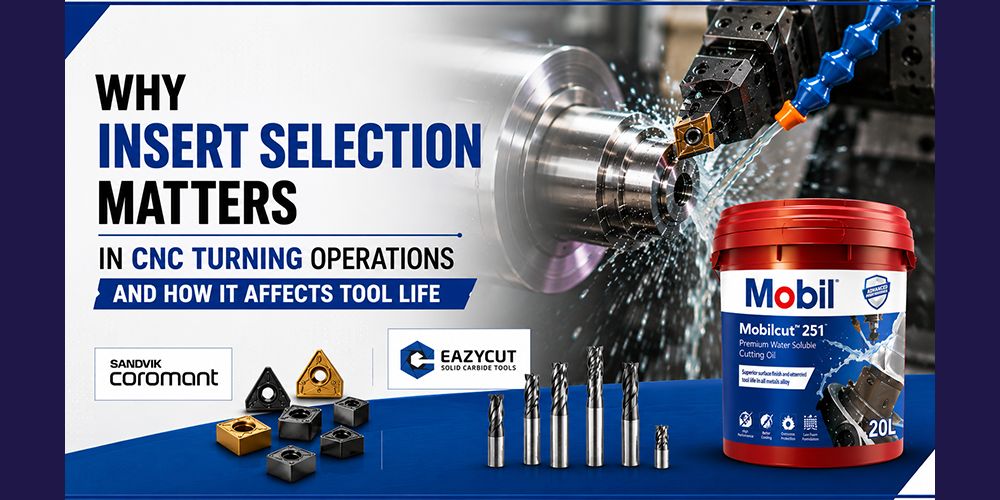
Why Insert Selection Matters in CNC Turning Operations and How It Affects Tool Life
Summary
In CNC turning operations, insert selection plays a much bigger role than most machining setups realize. The insert directly affects cutting stability, heat generation, chip control, surface finish and overall tool life. Many common shop-floor issues such as premature wear, edge chipping, vibration and inconsistent machining results are often connected to using the wrong insert geometry, grade or coating.
This article explains how insert selection impacts machining performance in real industrial conditions and why experienced production teams treat insert choice as a process decision rather than just a tooling purchase.
Table of Contents
- Understanding the Role of Inserts in CNC Turning
- Why Insert Selection Directly Affects Tool Life
- Common Problems Caused by Incorrect Insert Selection
- Material Type and Insert Matching
- Why Insert Geometry Matters in Real Machining Conditions
- Insert Coatings and Heat Management
- How Cutting Fluids Support Insert Performance
- Relevant Tooling Solutions for CNC Turning Operations
- A Practical Insert Selection Approach Used in Industries
- Final Thoughts
- FAQs
1. Understanding the Role of Inserts in CNC Turning
In CNC turning, the insert is the actual cutting edge responsible for removing material from the workpiece. While the machine, holder and cutting parameters are important, the insert ultimately decides how stable and efficient the machining operation becomes.
A properly selected insert helps achieve:
- Stable cutting performance
- Better chip control
- Longer tool life
- Improved surface finish
- Reduced machine load
On the other hand, an incorrect insert can create continuous machining problems even if the machine condition is good.
2. Why Insert Selection Directly Affects Tool Life
Tool life is not controlled only by cutting speed or feed rate. Insert selection itself has a direct impact on:
| Machining Factor | Effect on Production |
| Insert Grade | Wear resistance and durability |
| Geometry | Cutting stability and chip flow |
| Coating | Heat resistance |
| Nose Radius | Surface finish and cutting pressure |
| Chipbreaker Design | Chip evacuation efficiency |
In real machining environments, improper insert selection usually increases heat generation and cutting pressure, leading to faster edge wear.
3. Common Problems Caused by Incorrect Insert Selection
Many production issues seen on the shop floor are linked to insert mismatch rather than machine failure.
Common examples include:
- Premature insert chipping
- Poor surface finish
- Long continuous chips
- Vibration during cutting
- Excessive heat generation
- Unstable machining performance
These problems become more visible in continuous production environments where machining consistency is critical.
4. Material Type and Insert Matching
Experienced machinists usually start insert selection by analyzing the material being machined.
Different materials behave differently during cutting:
| Work Material | Insert Requirement |
| Mild Steel | Balanced toughness and chip control |
| Stainless Steel | Better heat resistance |
| Cast Iron | High wear resistance |
| Hardened Steel | Strong coated carbide grade |
Using the wrong insert for the material often reduces both productivity and insert life.
5. Why Insert Geometry Matters in Real Machining Conditions
Insert geometry controls how the tool enters the cut and how chips move away from the cutting zone.
For example:
- Positive geometry inserts reduce cutting force and are useful for smoother operations.
- Negative geometry inserts provide stronger cutting edges for heavy machining.
- Sharp edge geometry improves finish quality.
- Strong edge preparation improves durability during roughing operations.
This is why experienced production teams evaluate geometry based on the operation rather than selecting inserts only by size.
6. Insert Coatings and Heat Management
During high-speed CNC turning, heat becomes one of the biggest reasons for insert wear.
Modern insert coatings help by:
- Improving thermal resistance
- Reducing friction
- Protecting the cutting edge
- Extending insert life
In continuous machining applications, coating quality directly affects machining stability and productivity.
7. How Cutting Fluids Support Insert Performance
Insert performance is closely connected with coolant and lubrication conditions.
Proper cutting fluids help:
- Reduce cutting temperature
- Improve chip evacuation
- Minimize edge damage
- Reduce friction during cutting
MOBILCUT 251 Premium Water Soluble Cutting Oil
This cutting fluid supports stable machining conditions and helps improve insert life during CNC turning operations.
8. Relevant Tooling Solutions for CNC Turning Operations
Reliable tooling solutions are important for maintaining machining consistency.
Relevant Product Categories
These tooling solutions are widely used in industries where machining accuracy, productivity and long-term performance are important.
9. A Practical Insert Selection Approach Used in Industries
Experienced machining teams usually evaluate insert selection in a structured way instead of relying on trial-and-error methods.
| Step | Evaluation Area |
| 1 | Workpiece material |
| 2 | Roughing or finishing operation |
| 3 | Cutting speed and feed |
| 4 | Machine rigidity |
| 5 | Chip control requirement |
| 6 | Coolant condition |
| 7 | Insert grade and geometry |
This practical approach improves machining stability and helps maintain predictable tool life.
10. Final Thoughts
Insert selection is one of the most important factors in CNC turning operations because it directly affects tool life, machining stability, chip control and surface finish. The right insert improves cutting consistency and productivity, while the wrong insert creates unnecessary wear, vibration and machining problems. In modern manufacturing environments where efficiency and process reliability matter, selecting the correct insert geometry, grade, and coating becomes a critical part of machining performance and for application-based guidance and reliable tooling solutions, manufacturers can connect with Sanjay Tools for expert support.
11. FAQs
- Why is insert selection important in CNC turning?
A. Because it directly affects tool life, chip control, surface finish and machining efficiency. - What causes insert chipping during machining?
A. Incorrect geometry, excessive heat, unstable cutting conditions or improper insert grade selection. - Does insert coating improve tool life?
A. Yes. Proper coatings improve heat resistance and reduce wear during machining. - How does cutting fluid help insert performance?
A. Cutting fluids reduce heat and friction while improving chip evacuation. - Which tooling solutions are relevant for CNC turning?
A. Sandvik cutting tools, EAZYCUT carbide tools and proper cutting fluids are commonly used in CNC turning applications.