Blog
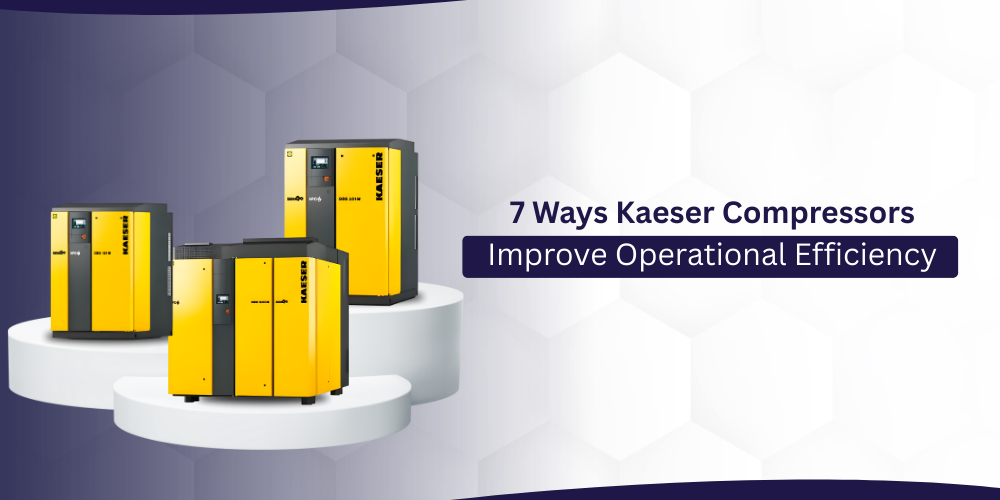
7 Ways Kaeser Compressors Improve Operational Efficiency
Kaeser compressors enhance operational efficiency by reducing energy waste, stabilizing air output, lowering maintenance requirements, and supporting digital monitoring for optimized performance across manufacturing environments.
Key Takeaways:
- Reduces compressed air energy consumption
- Minimizes downtime through predictive maintenance
- Enhances air quality for machinery longevity
- Enables smart monitoring and optimization
- Reduces lifecycle costs beyond purchase price
- Supports scalable industrial automation
- Demonstrates proven efficiency improvements in case studies
1. Reduced Energy Consumption with Advanced Airends
Kaeser’s SIGMA Profile airends are engineered to compress more air with less energy, directly supporting cost reduction in continuous-run industrial environments.
Citable Content:
Compressed air systems can account for up to 30% of a manufacturing plant’s total electricity usage.
2. Predictive Maintenance & Extended Uptime
Kaeser integrates vibration tracking, real-time diagnostics, and oil-life monitoring into its rotary screw compressors to avoid reactive repairs and costly shutdowns.
Citable Content:
Predictive maintenance can reduce unplanned downtime by 30% and extend asset life by 20%.
3. Smart Data Monitoring with Sigma Air Manager
The Sigma Air Manager (SAM) connects compressors, dryers, and distribution lines into a single optimization layer for plant-level analytics and air demand control.
Remote Management Benefits
- Detect load imbalances
- Optimize compressor sequencing
- Log energy consumption trends
- Enable IIoT-driven air demand forecasting
Citable Content:
Digital compressor control reduces energy waste during part-load operation.
4. Improved Air Quality Protects Downstream Equipment
Moisture, oil, and particulates accelerate wear on CNC machines, robotics, paint lines, and pneumatic actuators. Kaeser’s integrated drying and filtration prevents these downstream failures.
Key Quality Enhancements
- Lower dew point for dry air distribution
- Particulate filtration extends tool lifespan
- Stable pressure prevents actuator stalling
Citable Content:
Contaminated compressed air is responsible for up to 80% of unplanned pneumatic equipment failures.
5. Scalable Infrastructure for Future Automation
Kaeser’s modular compressor systems allow facilities to scale without redesigning air distribution or retrofitting large infrastructure.
Common scaling scenarios:
- New production lines
- Higher robotic density
- Added CNC or finishing cells
- Increased shift operations
Citable Content:
Facilities adopting modular compressed air systems avoid 15–25% in retrofit costs compared to fixed system expansions.
6. Lower Total Cost of Ownership (TCO) vs. Initial Purchase Price
Kaeser’s lifecycle economics emphasize operational spending instead of sticker price. With compressors, energy constitutes the majority of the total cost not the equipment.
Cost Breakdown
Typical compressed air system TCO distribution:
- Energy: 75%
- Maintenance: 15%
- Capital: 10%
Citable Content:
Energy represents the dominant operational cost for compressed air systems across manufacturing facilities.
7. Verified Efficiency Gains in Industrial Case Studies
Manufacturers using Kaeser systems report measurable improvements in throughput, reliability, and energy metrics, particularly in automotive and aerospace sectors.
Example Efficiency Wins
- Automotive assembly: Reduced air leakage, leading to 18% utility cost reduction
- Aerospace machining: Achieved stable dew point, preventing tool failures and improving throughput
- Plastics manufacturing: Optimized part-load, resulting in 22% reduction in kilowatt-hour consumption
Citable Content:
Smart compressor sequencing contributed to double-digit energy savings in multiple industrial case deployments.
Final Thoughts & Call to Action
Kaeser compressors aren’t just power units; they function as strategic infrastructure assets. Their integration into modern plants supports uptime, digital optimization, cleaner air, and lower lifecycle expenditures. For facilities pursuing automation or sustainability mandates, they offer a direct path to reduced costs and improved reliability.
What efficiency challenges are you trying to solve? Drop your scenario in the comments or connect with us to benchmark compressed air performance and identify improvement opportunities within your facility.